Current and past research, from perceptual training of elite athletes to fall-risk monitoring at home.
VR perceptual training in ice hockey
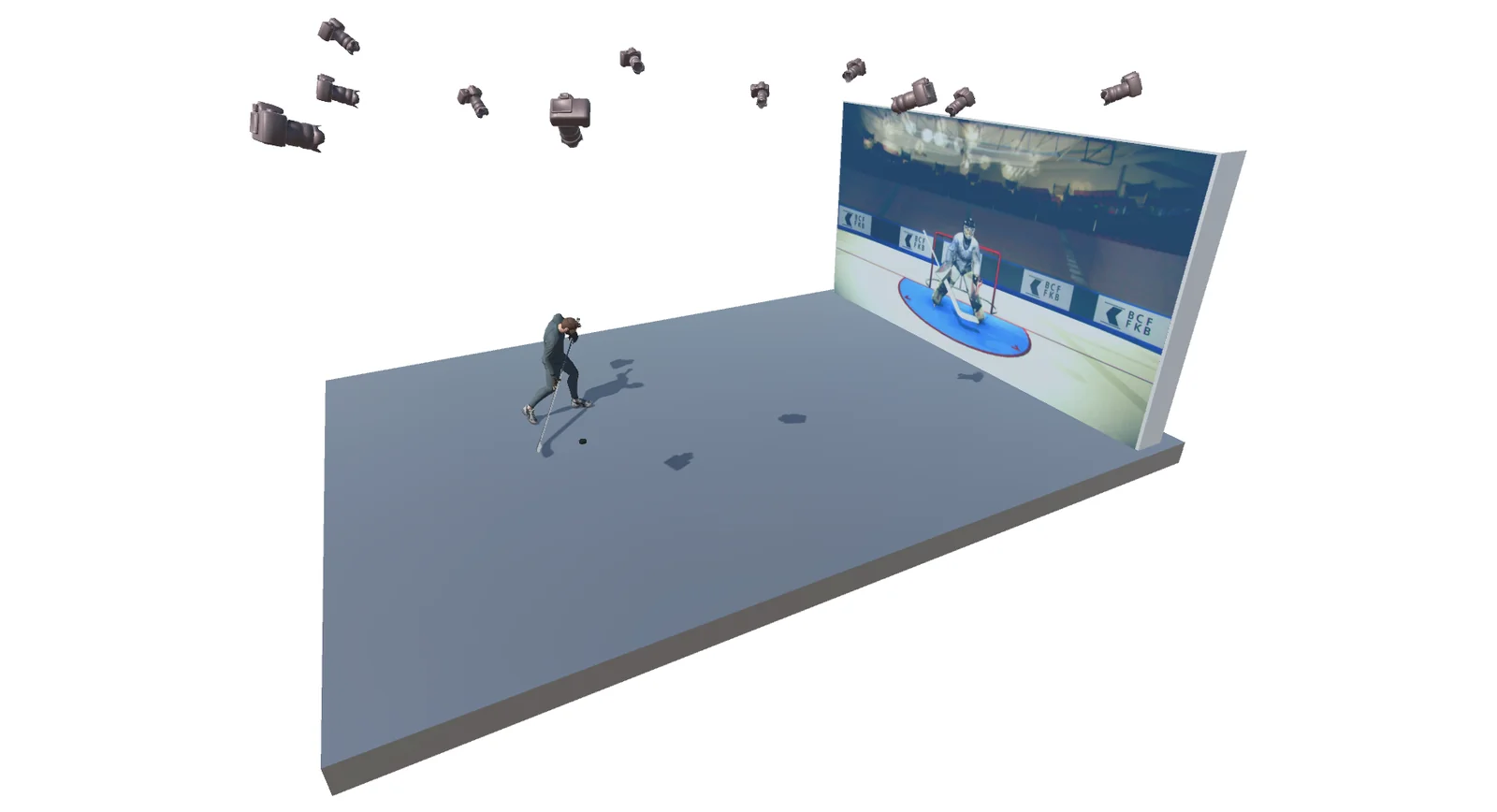
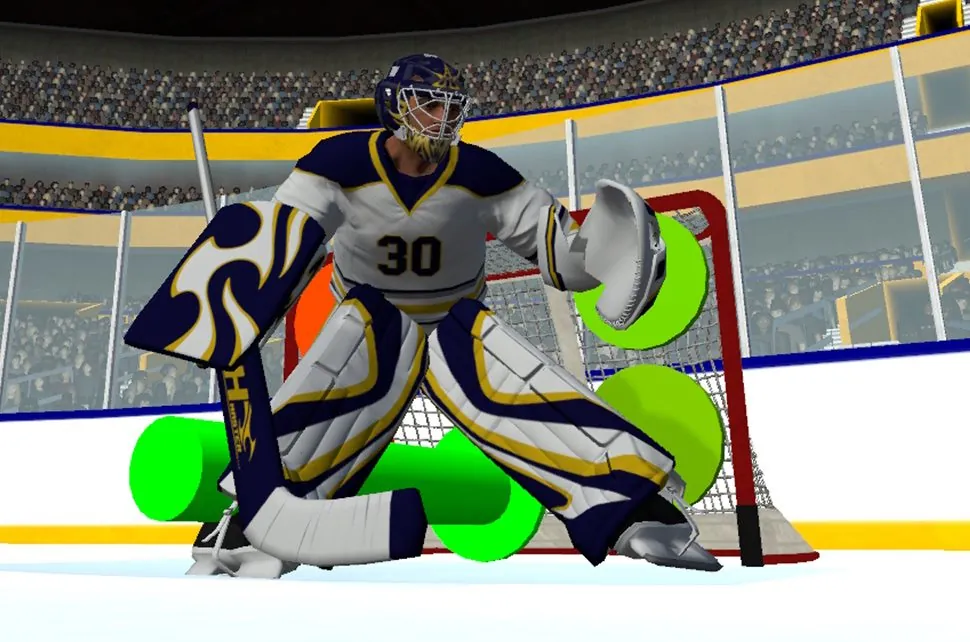
Player's view in the VR simulator: goaltender in standing position, five target areas displayed in the goal.Play the videoVR perceptual training in ice hockey — demonstration. Playing it loads content from YouTube; you can also watch it on YouTube.
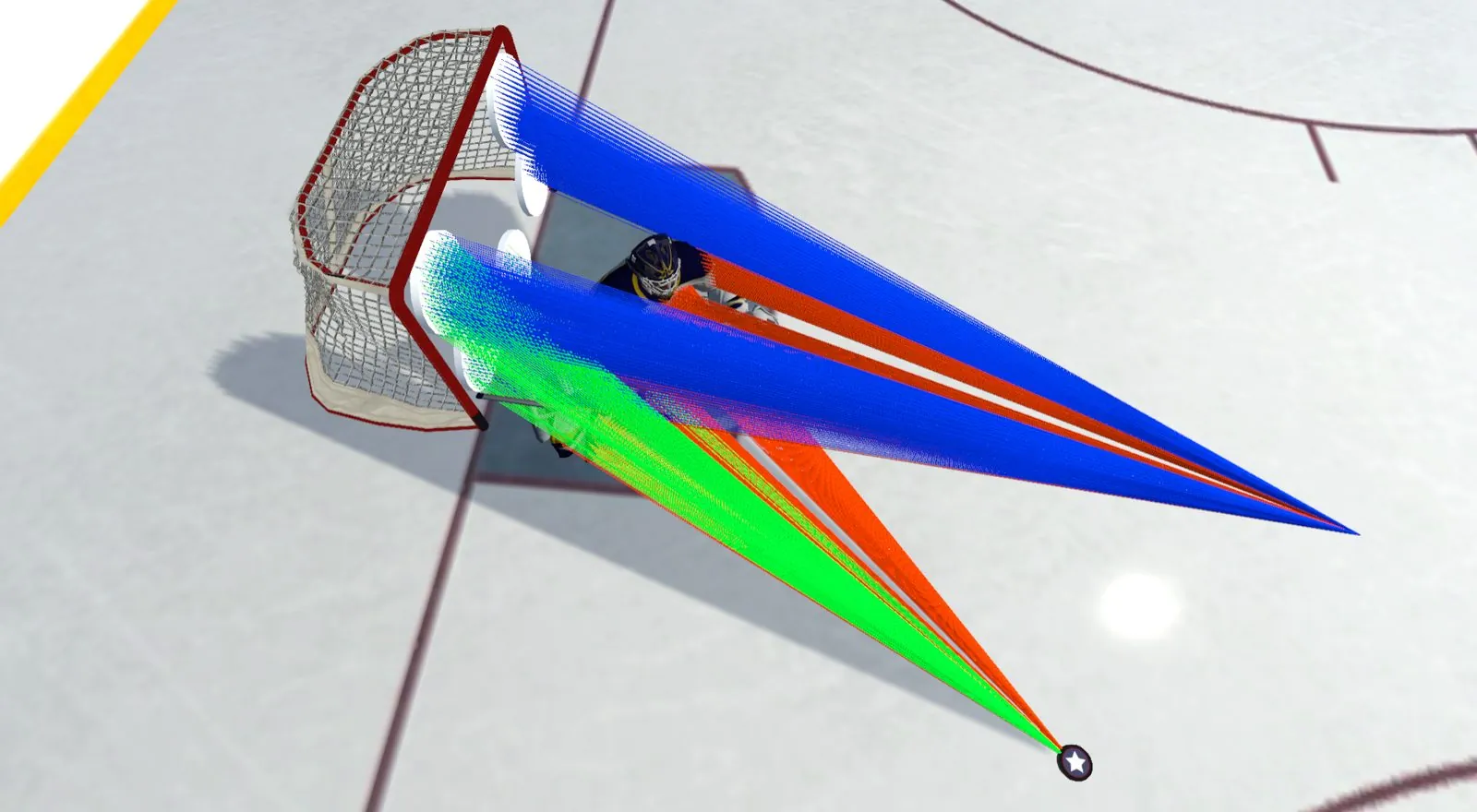
A virtual reality simulator that trains ice hockey players to identify the largest exposed area (LEA): the part of the goal least covered by the goaltender, as seen from the puck.
The puck does not see what the eyes see, yet only the puck has to cross the goal line. Players therefore have to learn to “see through the eyes of the puck”.
+15%perceptual performance after a single 15-minute session
In collaboration with HC Fribourg-Gottéron.
Key features
34 professional Swiss National League players tested
Pimax 5K XR headset with a 200° diagonal field of view
Approach angles from ±5° to ±45°, shooting distances from 3.5 to 7.5 m
Visual feedback combining colour-coded targets and a unique puck-view perspective
Virtual goaltender animated from the motion-captured movements of a professional Swiss National League goalkeeper
Target clearance is computed by ray casting, 121 rays per target: eyes’ view in blue, puck’s view in green; red rays are blocked by the goaltender.
Feedback from the puck’s point of view: the target that was really open.
Motion capture of the goaltender in our lab, used to animate the virtual goaltender.
Results
A single 15-minute training session improved perceptual performance by 15% in professional players — a substantial gain for athletes already at the highest level. The feedback also removed the negative effect of the eyes–puck difference on performance.
Bloechle JL, Audiffren J, Sauthier Q, Mertenat Q, Waeber Y, Aebischer D, Bresciani JP (2025). Perceptual training in ice hockey: bridging the eyes-puck gap using virtual reality. Sports Medicine – Open, 11, 38.
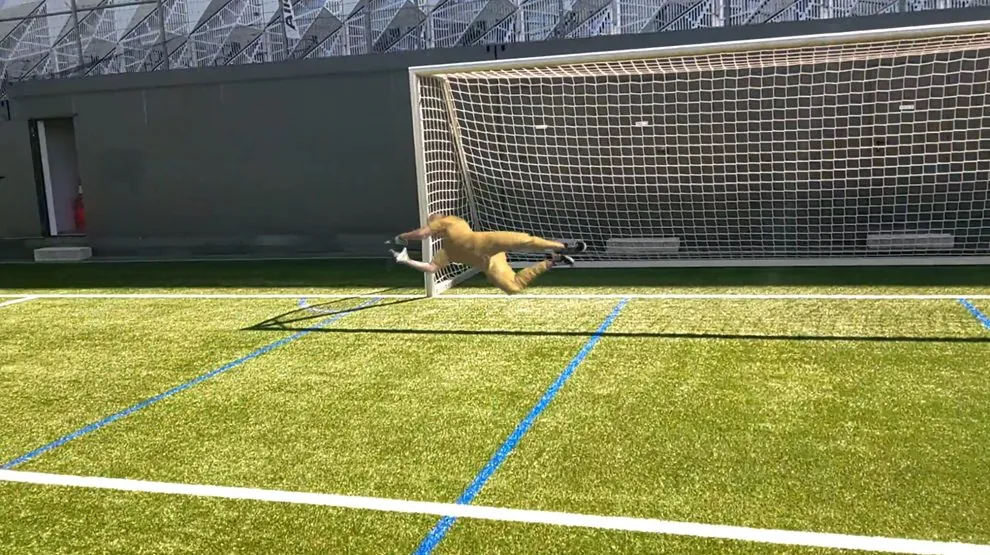
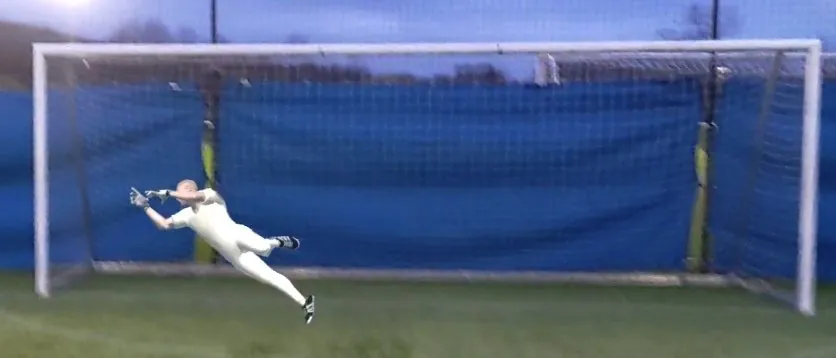
Seen through the Microsoft HoloLens 2: the holographic goalkeeper dives in a real goal, on a real pitch.
An augmented reality simulator to assess and train the sensorimotor skill behind successful penalty kicks: redirecting the kick in response to the goalkeeper's anticipatory movements.
Players kick real balls toward a real goal on a real pitch, but face a holographic goalkeeper displayed through a Microsoft HoloLens 2. The setup combines the ecological validity of real kicking with the experimental control of virtual environments.
−120 msredirection threshold after 10 sessions (−28%)
Key features
13 elite youth players (U16–U18, FC Basel and FC Luzern) and 8 Swiss national team players tested
The goalkeeper's dive is triggered in real time from the player's run-up kinematics
Machine learning (Bayesian network) adjusts task difficulty to optimise the learning rate
Goalkeeper animated from the motion-captured movements of a professional goalkeeper
LiDAR sensor (240 Hz) for precise foot–ball contact timing
Why the kick can be redirected
About 400 ms for the ball to reach the goal, against about 900 ms for the goalkeeper to react (200 ms visual, 700 ms motor): the goalkeeper has to move before the kick.
Professional goalkeepers dive to one side in 94% of penalties, and 75% of professional kickers wait for that dive.
Redirecting the kick at the last moment is only possible if enough time remains before contact, a fine sensorimotor skill. One penalty in three is missed.
SimulKick 2024 on the pitch: targets shown in AR, LiDAR and cameras around the penalty spot.
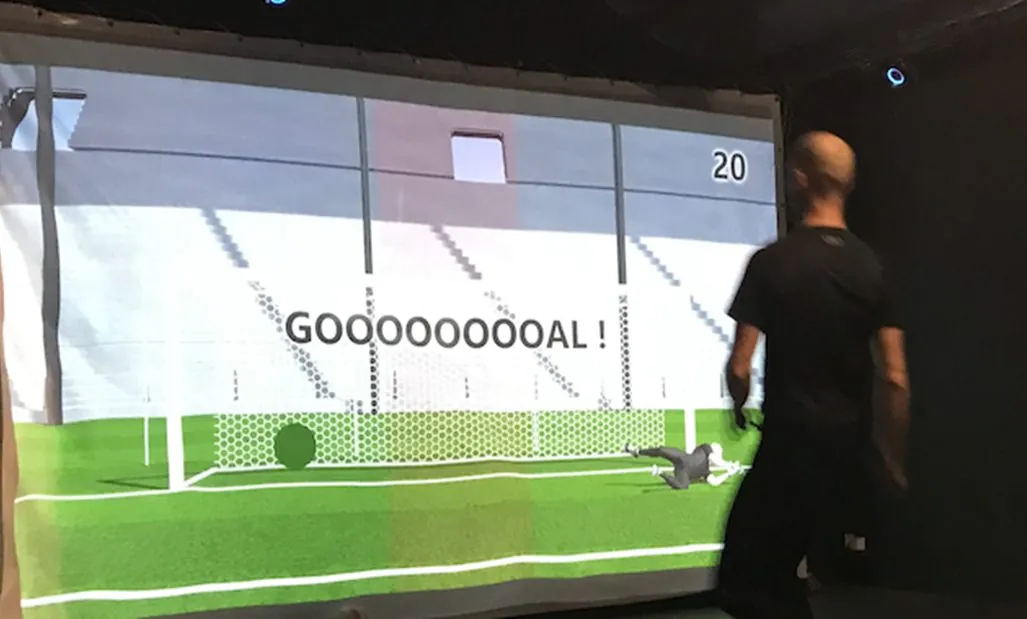
SimulKick 2020: the first, indoor version, kicking at an impact screen.
The motion-captured goalkeeper dive, as a hologram in the real goal.
Results
Ten sessions of 20 kicks reduced the redirection threshold by 120 ms (28%), an estimated 35% improvement in penalty success rate. All 13 players improved.
Bloechle JL, Audiffren J, Le Naour T, Alli A, Simoni D, Wüthrich G, Bresciani JP (2024). It's not all in your feet: improving penalty kick performance with human-avatar interaction and machine learning. The Innovation, 5(2), 100584.
The slap-shot simulator: the virtual goaltender reacts to the player’s real shooting preparation.
A VR slap-shot simulator that improves shooting performance in ice hockey through personalised training driven by optimisation algorithms.
The simulator analyses the biomechanics of the player's shooting motion and gives real-time feedback on technique. As in the penalty simulator, the virtual goaltender reacts to the player's real movements, creating representative game-like situations.
Key features
Real-time motion tracking of the shooting technique
Virtual goaltender animated from motion-capture recordings of a professional goaltender
Le Naour T, Hayoz L, Bresciani JP (2020). Human-avatar interaction in virtual environment to assess and train sensorimotor skills: application to the slap shot in hockey. International Journal of Virtual Reality, 20(2), 36–54.
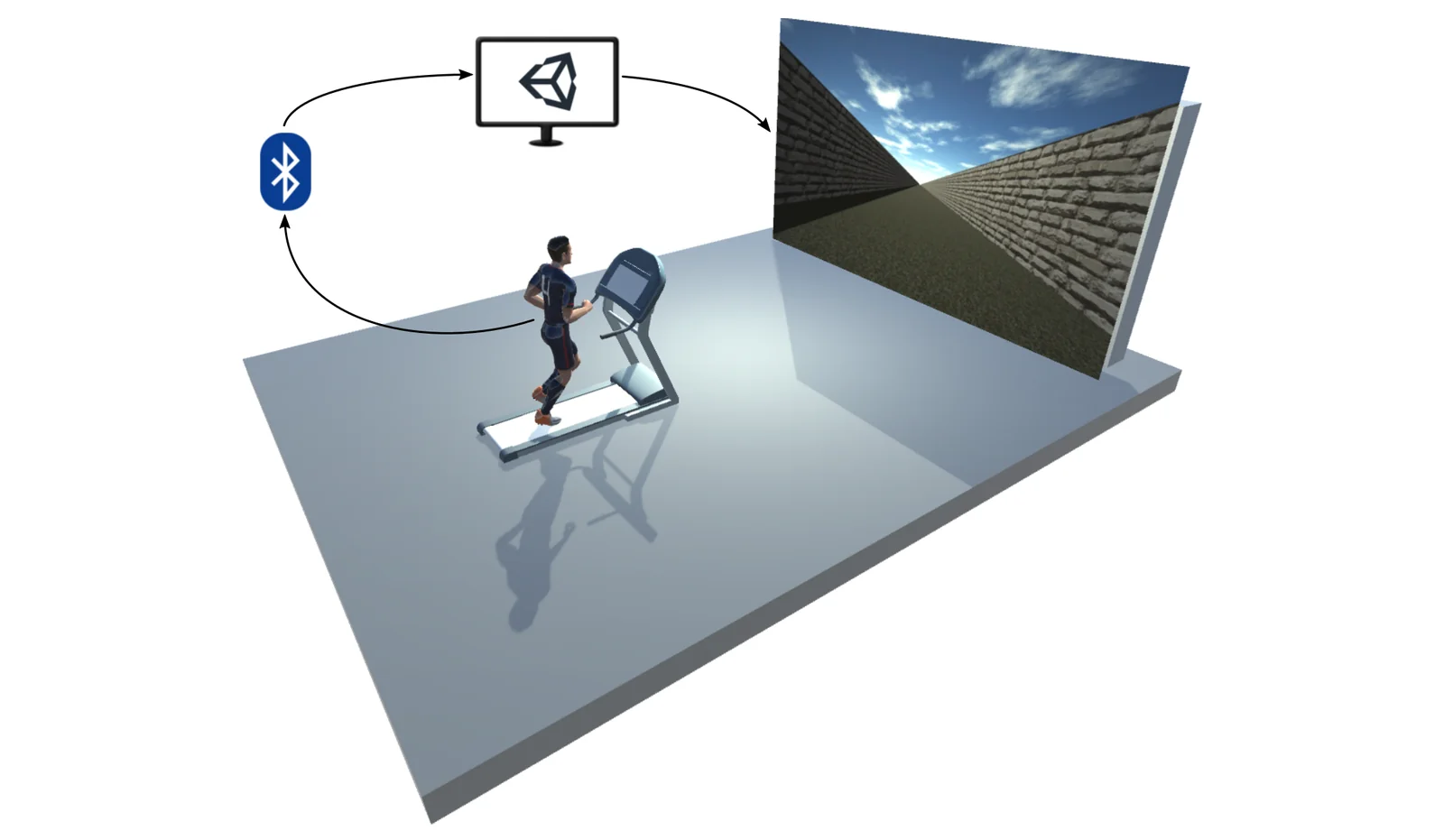
Treadmill in front of the 5 × 3 m projection screen; speed and properties of the visual scene are manipulated independently of the runner.
How do visual and kinesthetic or efferent cues interact during walking and running? Do the characteristics of a visual scene change perceived locomotor speed or perceived effort?
This project investigates the multisensory integration underlying the perception of self-motion, with implications for rehabilitation, sports training and the design of VR applications.
Set-up
Participants walk or run on a treadmill facing a large projection screen (5 × 3 m)
Speed and visual properties of the scene (slope, contrast, optical flow…) are manipulated
Perceptual judgements (speed, effort) and physiological measures are recorded simultaneously
Research questions
How does visual flow speed influence perceived walking and running speed?
Can visual manipulations change perceived exertion?
What are the limits of visual–kinesthetic recalibration?
Goalkeepers' perceptual strategies for the penalty kick
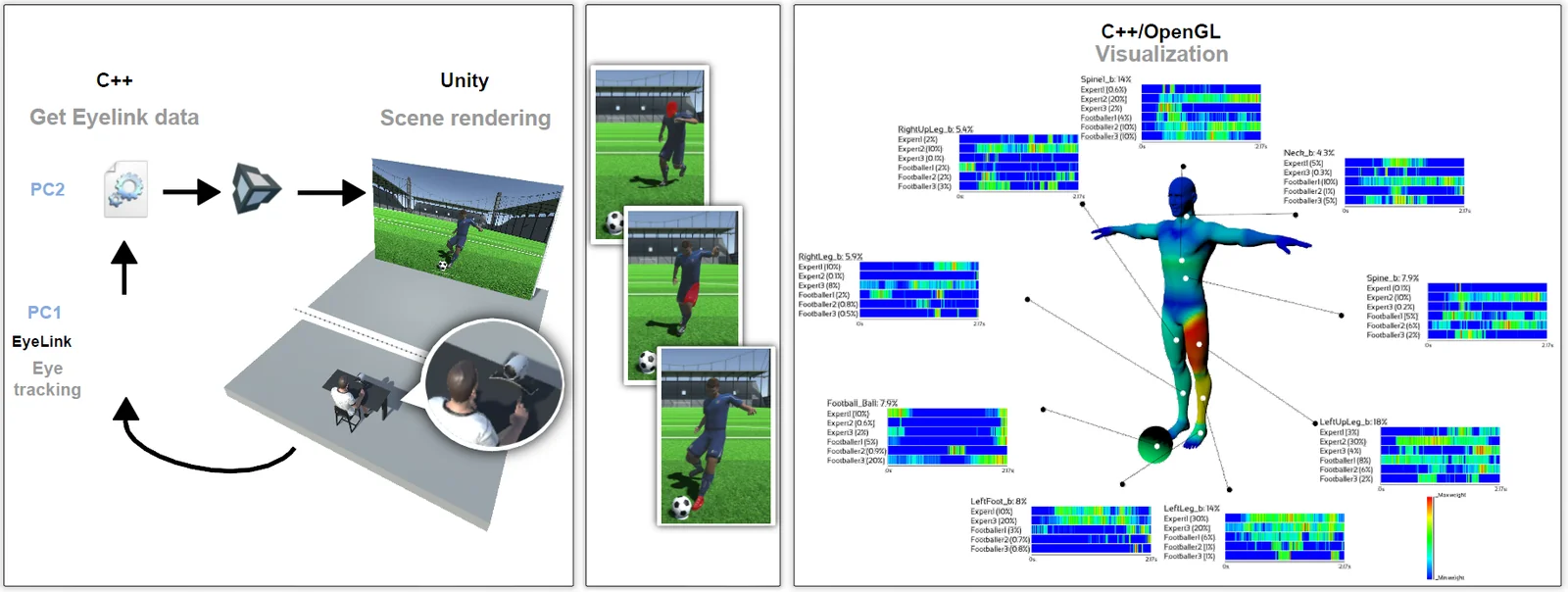
Gaze of a goalkeeper anticipating the kick of a motion-captured virtual penalty taker, analysed with the lab’s visualisation tool.
Which perceptual strategies lead to the best goalkeeping performance? Are some gaze patterns linked to better anticipation? Do experts look differently from novices?
Using eye tracking, this project analyses how goalkeepers extract information from a penalty taker's approach, to inform goalkeeper training protocols.
Set-up
Goalkeepers watch the run-up of a virtual kicker and anticipate the kick direction before ball contact
Kickers are virtual avatars animated from the motion-captured movements of semi-professional players
Eye movements are recorded with integrated eye tracking
Which body regions provide the most reliable cues for anticipation?
How does gaze behaviour differ between successful and unsuccessful saves?
Can targeted gaze training improve anticipation?
Fall prevention and detection in older adults
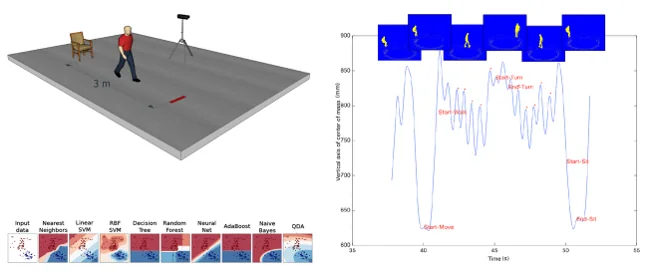
Kinect recording of an everyday task (top left), extracted gait and movement parameters (right), and classification by fall risk (bottom left).
Falls often lead to serious complications in ageing populations: fractures, loss of independence, reduced quality of life. This project defines fall-risk indicators that can be monitored routinely at home with ambient sensors, enabling early intervention.
Set-up
Participants perform everyday motor tasks: standing up, walking, turning, sitting down
A Microsoft Kinect depth sensor captures their movements without any worn device
Gait parameters, movement patterns and balance indicators are extracted automatically
Analysis
Machine learning classifies individuals by fall risk (e.g. low vs high)
Longitudinal tracking detects changes in motor patterns over time
The goal is to identify at-risk individuals before a fall occurs


 Play the video